Archive by Author | Anis Ettehadulhagh

”A hero is someone who understands the responsibility that comes with his freedom”. -Bob Dylan

It is hard to raise a child. Even in the best of times. A girl grows to be a mother; transmitter of culture, first educator of the next generation. A nation, it is said,finds it hard to rise above the moral acuity of its women. A great responsibility, which sadly is lost upon many, as time progresses. A boy grows to lead, provide, protect, and sacrifice his life if need be. His success and resources are to benefit everyone else in a society. Sadly in today’s world, this is lost even more often. Only a father, can adequately raise a boy to become a man. 2 things usually happen when poorly raised as a boy.

-The first is ”Hyper destruction”. The male quest for perfection, and the competitive drive and aggression, if poorly channeled, as we see upon the breakdown of civilisation(such as in war), leads to tragedy. Crime runs rampant, and the better angels of our nature have their very existence questioned. The human condition is not protected, and the uneducated man becomes a predatory fiend, instead of a protective friend.

-The second is ”Hyper passivity”. This we see more often daily. When this great male energy which gave us space travel, skyscrapers, machinery, sewage system, the internet, the harnessing of electric power, the discovery of continents, the founding of cities, etc… is poorly educated, many, fearing the previous outcome, seek to almost behaviourally and culturally ”castrate” men and boys from a young age. This leads to feelings of humiliation and emasculation. Achievements stagnate, frustrations occur in everyone concerned, and as every criminal in peace-time would attest, a humiliated masculinity, is a dangerous masculinity. Ask any school-shooter. A ”compensatory” mindset in the ”castrated” male ensues. Sadly many passive fathers, clueless mothers, and a well-meaning but inadequate educational system, produces such males. They are harmless, then after feelings of inadequacy reach a tipping point, they explode and implode, leading to grief and destruction affecting themselves and others.

Achilles, from Homer’s ”The Iliad” is a character than spans this spectrum. The name itself, is telling. ἄχος (áchos) “pain, sorrow,” and λαός (laós) “people, nation”, resulting in Akhí-lāu̯os “he who has the people distressed” or “he whose people have distress”. The pain or sorrow of the people is a theme raised numerous times in the Iliad and frequently by Achilles himself.

The name thus obtains a double meaning in the poem: when the hero is functioning rightly, he brings distress and pain to the enemy, but when wrongly, his own people/nation/men get the grief of his deeds. The poem is indeed partly about the misdirection of anger/masculine drive, as pertaining to action and leadership. Pain and grief shall occur. But they should not be misplaced, like anything else in life.

This brings us to the third option. The result of a well educated man; A Hero! Characterised by; Propriety. Morality. Responsibility. Accountability. Temperance. Action. When a male holds these, among others, in his character and channels his drive, he brings joy and light to what/whom is deserving, and distress/grief when required.

If the first destructive option is a hyena, and the second weak but dangerous option is a jackal, this third heroic option is, without putting too fine a point on it, a lion. Silent as a mouse if necessary, and a thundering roar should the need arise. Propriety!

No aimless roaming without education or direction, and not curtailed/castrated nor humiliated. Channeled, driven and educated. Such is a leonine hero. Such is expected of every son of Man…

 ”He is My true follower who, if he come to a valley of pure gold, will pass straight through it aloof as a cloud, and will neither turn back, nor pause. Such a man is, assuredly, of Me. From his garment the Concourse on high can inhale the fragrance of sanctity…. And if he met the fairest and most comely of women, he would not feel his heart seduced by the least shadow of desire for her beauty. Such an one, indeed, is the creation of spotless chastity. Thus instructeth you the Pen of the Ancient of Days, as bidden by your Lord, the Almighty, the All-Bountiful.”

-Bahá’u’lláh

“It is better to be violent, if there is violence in our hearts, than to put on the cloak of non-violence to cover impotence.’’

 – Mahatma Gandhi

Modern psychology generally employs the term, ‘’integrated violence.’’

Without going into very much detail, this broadly refers to the ABILITY someone has to become violent, justifiably, should the need arise (Defending one’s own self, or another, from potentially lethal harm), but never ever engaging in violence otherwise. In other words, self-control, maturity, (moral) education, socialisation, etc… Yours truly does not necessarily agree with words such as ‘’taming’’ especially in today’s attempts at feminising men and boys, and demonising masculinity; we see how in times of crisis, the world returns to praising men and traditional masculinity (COVID-19 style). It therefore is always to be maintained and celebrated. However, that is a separate issue.

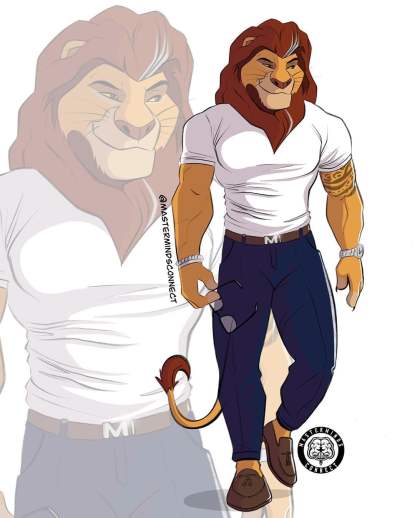
Therefore, being ABLE to become violent should the need arise, but otherwise NOT engaging in it, is the hallmark of every mature soul, especially, but NOT limited to, masculine archetypes. Many modern works use Mufasa, from the Lion King, as the epitome and symbol of this integrated violence within one’s character-particularly the scene where he stands on Pride Rock at the beginning of the film, as Zazu flies towards him. The stern look on his face, is immediately contrasted with his smile at Zazu.

Or when he tells Simba he is only brave and fights when he must, before playing with his son, after he has given the hyenas a sound thrashing.

Violence, and the ability to fight, are not in themselves evil or dirty. Like all else, context is key. Food in a plate is nourishment and even artwork. But on your shirt, is simply dirt. Greed is horrible and the cause of many ills, but greed in the acquisition of knowledge, arts and sciences, is salutary and worth striving towards. Anger is a chimera, but being angry at injustice, especially when directed at others and the disenfranchised, can be a fuel for betterment and change. Context! Context! Context!

Same with violence/fighting. Even Gandhi, clearly opposed to it, basically divided it into three, as a cursory look at his works would show- same with Mandela.

It is basically what religion, in its unadulterated form has been saying for 10 thousand years, and is very linked to the emotional state of the individual, intention, purpose, and so forth;

-The non-violence of the strong.

This is a situation where the principal actor is CAPABLE of using violence but unwilling to do so. It is driven by his strong desire for the pursuit of the right ends, using the right means. This is what we are to aim for.

-Violence in suspension

This is a scenario where the principal actor INTENDS and WANTS to use violence but is constrained by external factors, such as witnesses, or fear of prison. Though common, and practically keeps some degree of order in society, this is not truly and ultimately virtuous, since Gandhi shared Aristotle’s conception of the exercise of virtue, as contingent on the act being done VOLUNTARILY, no matter what.

 Like Socrates saying, an unexamined life is not worth living. Similar to Robinson Crusoe, the protagonist in Daniel Defoe’s classic, musing within himself, that, was not committing anything untoward after being stranded on a desert island for over 25 years, because he was moral and disciplined; or simply because there was nobody to test him, tempt him, try his patience, his virtue, etc… So, this is suboptimal, since it is not truly INTEGRATED, but rather driven by external factors, which are subject to change. Many such practitioners of this category should civilization break down due to war/civil unrest, resort to their baser tendencies.

-Non-violence of the coward

This is the form of non-violence where the principal actor is both INCAPABLE of and is UNWILLING to challenge his opponent, due to fear/cowardice. This type of non-violence is but a shield to hide one’s own impotence; a farce if you will. Even misdirected courage, as opposed to cowardice, is preferable, since virtue, in its purest form, is the pursuit of the Good, which leaves no room for the cowardly.

And that is what the opening quote refers to; it is ultimately best to be able to become violent and dangerous should the NEED arise (against the forces of evil, so to speak) than to be a coward, unable and unwilling and fearful to fight when need be, and yet PRETEND to be peaceful. Better to be violent when you feel it, if it really is what you want, since that at least would be more honest, and less cowardly, than to pretend and fake peaceful vibes. Do not hide behind lofty terms to mask your inadequacies.

And many are like this today. Many choose friends and even partners for relationships because they seem ‘’decent’’ or ‘’nice’’ when in fact they are harmless, and there is no virtue in being harmless, like a hamster, or lemming.

Such a person is useless in times of crisis, and those around him when they realise what they thought was ‘’nice’’ was actually ‘’harmless’’ (the third category previously discussed) it is often too late. Repeated disappointment has transpired, and mistrust has developed in the relationship. And they (the harmless ones, masquerading as ‘’nice and decent’’) build up resentment for themselves and those around them. This process, at best, leads to ugliness amongst relations between people, as well as long-term lack of trust; and at worst, actual societal harm (Some researchers have put not all, but a number of mass-shooters, and sympathisers of totalitarian regimes in this category actually; also for several additional reasons), in an attempt to ‘’compensate’’ for these feelings of inadequacy and impotence.

Thus, HAVE the capacity for violence, but BE NOT violent, unless and until absolutely necessary; hence, one embodies the very epitome of self-control, strength, calmness, and reliability-like Mufasa 😊.

Those who mistake this for harshness, are as blind as those who mistake being harmless for being nice/decent-and their views are flawed and do not count. They too must seek to re-evaluate their criteria for interacting with humans, as well as take an introspective look at themselves.

Such individual human maturity, shall lead to a greater societal maturity, as previously discussed in several posts.

The inauguration of a world civilization such as no mortal eye hath ever beheld or human mind conceived…Who is it that can imagine the lofty standard which such a civilization, as it unfolds itself, is destined to attain? Who can measure the heights to which human intelligence, liberated from its shackles, will soar? Who can visualize the realms which the human spirit, vitalized by the outpouring light of Bahá’u’lláh, shining in the plenitude of its glory, will discover?” – Shoghi Effendi

Artist vs Scientist

“Every morning when I wake up, I experience an exquisite joy —the joy of being Salvador Dalí— and I ask myself in rapture: What wonderful things is this Salvador Dalí going to accomplish today?” Salvador Dalí

“Science without religion is lame, religion without science is blind.”

― Albert Einstein

Science and Religion and Art, and all fields of knowledge and human pursuits of excellence are laudable and to be respected, as are those who engage in them. They have always been and shall always be in harmony with one another, despite what certain individuals say.

So this modest monograph if you will, is not about disputing that; rather it is about addressing what seems to be going around more ubiquitously today (due to the prevalence of among other things, social media) than before; why does it FEEL worse when an artist commits an atrocity, than when a scientist does?

Clearly it is possible to enjoy the work of an artist, despite atrocities committed. Countless actors, and singers have been found guilty of essentially paedophilia, manslaughter, murder, death by misadventure/negligence (Even Mathew Broderick, Don King, etc…), and others suspected of atrocities such as Michael Jackson, and others who have been KNOWN to indulge in horrid acts for decades with impunity (Bill Cosby, Weinstein, Jimmy Saville who was awarded honours by sports outlets, the Papacy, medical institutions, etc…for his work with sick kids, within radio, TV and sports, it turned out had raped over 400 people, from as young as 6 years old to people in their sixties and even corpses. Remember his catchphrase? ‘’Jimmy will fix it!’’…or something of the sort) Roman Polanski is a convicted paedophile who still wins awards and produces films. The list is endless, no need to continue, lest this becomes voluminous.

The point is, why do people feel MORE betrayed when an artist commits an atrocity, than when a scientist does. Most likely because of several reasons.

As the quotes headlining this suggest (There are SEVERAL quotes from both scientists and artists that are amazing and others that are abysmal. That is not the point. Those two were chosen, partly because in the image are Dali and Einstein), within the attitude of the artist, the starting point is often HIMSELF, whilst with the scientist, the starting point is often the TASK. This is highlighted in their respective quotes.

Still, they both produce truths, and joys, and knowledge, and works that touch people’s souls and minds and enable us to soar towards heights and experience sensations we never knew we could.

’Arts, crafts and sciences uplift the world of being, and are conducive to its exaltation.’’ -Bahá’u’lláh

 Again, not a knock on either one or exalting one over the other. Just seeking to understand why people feel more betrayed when an artist is guilty, or even simply accused, than when a scientist is, even though we can and often do, separate the artist form the work (many have no problem consuming Cosby’s works until forever, and that is their prerogative).

So, as aforementioned, one reason is the fact that the artist is very ‘’present’’. Therefore, the consumer feels a closer connection to them. Everyone knows who sang ‘’Thriller,’’ but how many know who invented the Television Set? (Many contributed, but Philo Farnsworth started it) Or the computer which we all use daily? (Charles Babbage pioneered that) Scientists tend to be more distanced from the public, for many reasons, not only because they focus on the topic/task, but the process usually takes longer and seems more ‘’boring’’ and distant/unemotional and uninvolving.

And if the guy who discovered gravity ends up being a rapist, we are still subject to gravity. But if the guy whose song you sang to your kid, or played at your wedding, turns out to be a paedophile, you do feel more ‘’betrayed’’.

Science appeals to everything, but also is more objective, and is in some ways less malleable. Art is more subjective and affects peoples’ feelings and reactions more. Therefore, even though we CAN and often DO separate the artist from the art, the feeling of betrayal can be more than it is towards science. Especially if the artist made an image of himself as a child-friendly, family man/woman.

Personally, I separate the work from the individual because I see the individual as a vessel, through which life, the universe, God, inspires. And any vessel/instrument, if poorly maintained, is subject to decay. Therefore I have no problem enjoying the works, fruits and successes of artists and scientists, even if they have proven themselves to be horrendous individuals; and by the same token, I value their work, and do not worship them as individuals.

Sure, we appreciate and respect their efforts, and condemn their misdeeds. But a useful and good work remains a useful and good work, regardless. With this attitude, I have no issues continuing to relate to the works, no matter what the individuals have done, since they were mere tools and vessels to begin with.

‘’All the existing arts and sciences were once hidden secrets of nature. By his command and control of nature man took them out of the plane of the invisible and revealed them in the plane of visibility, whereas according to the exigencies of nature these secrets should have remained latent and concealed.’’ – ‘Abdu’l-Bahá

But I however understand the outrage; it just seems like those who cannot separate the two, is usually because they put too much importance on the individuals/vessels/tools to begin with. But I understand the sentiment.

A scrutinising look at most ‘’great achievers’’ would uncover anything from misdeeds to downright atrocities. Does this mean the world should deprive itself of all the vaccines, and mechanics, and art, and treatments, and poetry, and films, and songs, etc…? Yours truly thinks absolutely not! And who draws the line that demarcates how good you must be at your craft, for the world to knowingly and willingly ignore your atrocities? Is there a gauge or standard measurement? Who decided it? Not the average person! And how much time must pass before their atrocities are ‘’forgiven’’ and even hailed? (See the post on ‘’time-dependent bias’’).

What they gave to the world, belongs to the masses now. It belongs to you and me. And with the masses they shall remain, and yours truly believes we can draw use from these fruits, guilt-free.

 Their atrocities, however, belong to them, and with them they shall remain. This is the only way to hold them accountable, without clouding the waters of reason and common sense, and without losing what inspiration gave US, albeit through THEM. Nobody is beyond morality. Nobody is above a principle. Nobody is exempt from the judgment of the Golden Rule, however ingenuous they may be.

In the end, aside from the Almighty Himself, EVERYONE is accountable for their thoughts, words and actions. And by the same token, everyone can be inspired to achieve and produce gems. With this in mind, let us all tread lightly along the path of righteousness, including in the pursuit of excellence, in fact, ESPECIALLY then. 

‘’The acquisition of sciences and the perfection of arts are considered acts of worship.’’ ‘Abdu’l-Bahá

Memento mori…

“Concentrate every minute..like a man— on doing what’s in front of you with precise and genuine seriousness, tenderly, willingly, with justice. And on freeing yourself from all other distractions. Yes, you can— if you do everything as if it were the last thing you were doing in your life, and stop being aimless…, stop being hypocritical, self-centered , irritable. You see how few things you have to do to live a satisfying and reverent life? If you can manage this, that’s all even the gods can ask of you.” –Marcus Aurelius

“We are all in the gutter, but some of us are looking at the stars.”

― Oscar Wilde

Challenges, pain and suffering; sorrows and disappointments-all immutable parts of life.

As the quote states, these touch us all. The only thing to deal with is why, and what we do with them. It is incumbent to realise that those who are face down in the gutter dwelling upon the wrongs being inflicted upon them, shall, not only never emerge therefrom, but if they do, be fraught with bitterness, resentment, deep-seated anger, etc…

Whilst those who keep their gaze upon the stars, not only find meaning in the suffering, in ‘’being in the gutter’’, but upon emergence, use the lessons gained to spread more lessons and goodwill. Some may even go so far as NOT seeing being in the gutter as necessarily negative. That, however, is a separate matter 😊.

What is the difference between the proverbial superhero and supervillain? We see these archetypes in mythology, comic books, folklore, religion, fables, etc…

Very often, across these platforms, they have similar, nearly identical experiences, and in some cases grow up together and are even related (Sabretooth and Wolverine)! However, the superhero states; ‘’because I have suffered, I shall do my absolute best to spare others from that suffering’’. The villain states: ‘’ As I have suffered, so shall everyone else. None shall be spared’’!

It is not necessarily experiences that determine our end, (though they doubtlessly contribute in shaping us) but how we REACT to them, is potentially a greater contributor.

Should you see yourself as number 1., deserving of every right and privilege, the slightest inconvenience leads to bitterness. But, (from the perspective of yours truly) should you see the Will of God as nr. 1, then your family, community, the greater mankind, then you are earliest nr. 4., or 5., and focused on duties and responsibilities, and ‘’protecting others’’ and keeping your gaze on the stars-a higher purpose. It becomes extremely difficult to fall into the grips of self-pity, anxiety, anger, bitterness, depression, or transforming into a ‘’villain’’.

CHALLENGES are what we need to grow. Pressure builds diamonds, resistance in training makes muscles grow, same is true for emotions, lifestyle, and spiritual difficulties; challenges, or ‘’being in the gutter’’ is how we will grow, provided we do not lose sight of our mission, goal, and keep doing our best-keeping our gaze on the stars (See previous posts on developing healthy habits and staying motivated).

There are myriads of statistics and research projects since the 90s that anyone can find and peruse, that showed stress levels of high school students in the USA, were equal to those of their agemates during the Yugoslav war. Or a major cause of suicide among kids 14-16 in the UK was exams. Currently there is ongoing research that Medscape is to publish about suicide amongst medical students, being the highest among all students. Not to talk of suicide among professionals, with medical doctors ‘’leading’’ the way. However, not to digress, the point being, should one focus on the challenges as an opportunity for growth and strength, as weights in a gymnasium, they shall not break you to the point of suicide. Sure it is more extensive that, but that is the baseline; focusing more on being there for others as your mission, and less on one’s own self, is the basis for help and the rest builds upon this; keep your gaze on the stars, whilst in the gutter!

A kid from war-torn Darfur, if put in a safe US or UK environment, and asked if he would take his own life should he fail the upcoming exams would say no, and simply take them again or turn his attention to other endeavours. Why? Because he would have been challenged to a greater extent, emotionally-hence a failed exam would not be the end of everything.

This is NOT to make light of depression, angst, or suicide, but rather to show the importance challenges, and how we PERCEIVE them, have upon how we REACT to them. Same challenge, different reaction, due to different interpretation, due to different manner in ‘’seeing’’ yourself; as nr. 4 or 5, instead of as nr. 1!

 Humility, self-effacement/selflessness, are key. And these must be upheld. Consistency in everything. You do not eat or shower once; same way these must be done daily, so too these qualities must be upheld every second of every minute of every day. It is a constant process, beginning from early on in life.

And the same way we need bigger and heavier weights as our muscles and strength grow in the gym, and must increase our caloric intake; so too as our character gets stronger, shall we encounter greater challenges along the way, and will therefore need even more tools, and greater humility and sharper focus on the stars, to stay our course. Failure to maintain this, is why certain stories begin so well, yet end so poorly-because those involved failed to increase the tools necessary to meet with ever-increasing challenges. Nothing stays the same-this includes challenges. Therefore, our tools for dealing with them must also be enhanced every step of the way. What sufficed yesterday, will not necessarily suffice tomorrow. Like ascending to the next level in a video game😉.

Failure to do this will lead to a failed exam being life-altering and catastrophic (they can be, but should not be the end of our world), and before long, an unanswered text message leading to self-inflicted harm(It happens, sadly). All the while, there are those who lose their spouses, children, in atrocities, who manage to not only survive but help others endure-because they kept and increased their tools of humility, and self-effacement, and focused on their mission and DUTIES, not just on their rights (It happened, let me grow and learn and prevent others from going through the same; not it happened, now to hell with creation, how dare this befalls ME!?!). They kept their gaze upon the stars.

While the children are yet in their infancy feed them from the breast of heavenly grace, foster them in the cradle of all excellence, rear them in the embrace of bounty. Give them the advantage of every useful kind of knowledge. Let them share in every new and rare and wondrous craft and art. Bring them up to work and strive, and accustom them to hardship. Teach them to dedicate their lives to matters of great import, and inspire them to undertake studies that will benefit mankind. – Abdu’l-Baha, Selections from the Writings of Abdu’l-Baha, p. 129.

”Some are born great, some achieve greatness, and some have greatness thrust upon them.”

-William Shakespeare

Very often in life, the effort one puts into training for a given purpose, is, at first sight, not necessarily proportional to the outcome.

For example, a trained actor who can recite Shakespeare, and Marivaux by heart in multiple languages, is an extra in a potato chips commercial. Or someone who has sacrificed and endured all his life for a given sport, performs for 22 seconds on the world-stage, wins a gold medal and that is all he has to show for two decades of hard work (Consequently, the depression that follows this is highlighted in a number of studies and documentaries).

And even upon fair recognition, it still seems like a mountain delivered a mouse, when compared to the effort put in; Bolt trains all his life, for a 9+ second performance. And he is one of the success stories!

The purpose here is not to say whether it is deserved or not, and how much is deserved, or what mistakes were made along the way. Rather, for, amongst other things, brevity, that, even though at times more is deserved, even when you do get what you deserve, it still seems less than the effort, time, blood, sweat, and tears that some put into an endeavour-and others stumble upon ‘’greatness’’, with little to no effort, as our boy, Billy states in the quote above.

The truth is, it does not matter how the world perceives what your positive efforts are, when they recognise it, and even IF AT ALL they do recognise these efforts; Mozart was not held in the highest esteem in his day, Galileo was imprisoned, Copernicus was executed, Vivaldi had the papers on which his symphonies were written, used to wrap and sell fish upon his impoverished death-yet we see 16 year olds achieving ‘’fame’’ and wealth and ‘’status’’ for taking photographs of their own faces in front of a mirror. Sadly, these things happen, and these self-absorbed teens have always existed since the dawn of time, and unrecognised Vivaldis will exist always, as well.

As long as you are fulfilling what you have been called upon to do (Finding what this is may take time, self-reflection, self-effacement, consulting with the appropriate souls, meditation, prayer, etc… but EVERYONE has, and can find their purpose. See other posts on this), and effecting a positive change upon yourself and those around you, and carrying forward an ‘’ever-advancing civilization’’, the rest is of little direct import to your life.

“All men have been created to carry forward an ever-advancing civilization.” –Bahá’u’lláh

Leading a decent way of life, contributing any way you can, focusing on morality every day (A simple, but NOT an easy task, especially long-term), with common sense and a pure heart, enables you to live, serve your world, and die as you should. You cannot influence how quickly nor how slowly your efforts get recognised, if at all they do; nor can you prevent others who make little effort from getting recognised. And nor should you try to! Perhaps the world needs to SEE the contrast. Focusing on this apparent injustice may lead to bitterness, burn-out, and certainly lack of focus on your part.

But, though it may initially seem like a mountain delivered a mouse, in the end, eventually, the best efforts come to light! The greatest contributions are unveiled! And those who serve the greater purpose and their deeds, eventually get recognised and frauds are also unveiled! That is an immutable truth throughout history.

This does not mean there are not unsung heroes, for there are. Countless contributors whose names we shall never know. But, their actions have effected a change, a positive change in our world- and this is ultimately what they worked for, and all they really cared about. So in the end, justice prevails, even though it may not always SEEM this way.

Doing this takes discipline, and like everything worth doing, is not easy. Nothing worth doing ever is. In fact, the difficult thing to do, and the mature/right thing to do, are very often one and the same thing.

Therefore, focus on living the productive and daily moral life; and WHEN (Not if, but rather when) your main purpose is found, stay the course, and let the rest of the chips fall where they may.

Blessed is the man of discipline and honesty and focus who remains true to his mission, undistracted, and undaunted by the gay livery of the nether world. However unfair things may seem, time has a way of revealing the truth; nothing remains hidden under the sun forever. Nothing at all.

“That which was applicable to human needs during the early history of the race can neither meet nor satisfy the demands of this day, this period of newness and consummation…Man must now become imbued with new virtues and powers, new moral standards, new capacities…The gifts and blessings of the period of youth, although timely and sufficient during the adolescence of mankind, are now incapable of meeting the requirements of its maturity.”- ‘Abdu’l-Bahá

”No social stability without individual stability”.

Aldous Huxley

Little unknown by now; and by the same token, much uncertainty. Whether or not one chooses to take things seriousy, the planet is in the grip of a worldwide pandemic due to COVID-19.

Consider when one starts a new activity, athletic or otherwise; sprinting, driving, drawing, painting, etc..all your ”weak spots” feel extra vulnerable as they must be strengthened, since they have not been thus challenged. Patients who contract illnesses where they become immunocompromised often report of ”flare-up pain and tenderness” in areas corresponding with previous injuries. In other words, a new situation, whatever the degree of tragedy, whether voluntary or not, whether self-imposed or not, highlights were we are weakest, and, however painful, is an opportunity for growth and improvement.

One can hold on the the little twig keeping us afloat to the point where one adamantly refuses rescue (See the story of the raft, by The Buddha), or one can use the twig to stabilise, improve, adapt, build a raft, and rescue others; become like Noah!

Every facet of our society proved wanting (even beyond what most people already believed), to varying degrees; the economy, the political landscape, the police/law enforcement agencies, the housing system, agriculture, entertainment, eduction system, healthcare, etc…

No longer can people deny the effects of human involvement in (accelerated) climate change; the planet was breathing better after 6 weeks. No longer can we claim schools and the workplace are family-friendly; over ten million kids in America alone rely entirely on school for meals (let alone many other countries, better and worse). No more denying that the economy is superficially viable and profoundly unjust at its very roots; it took 8 weeks to reach Great Depression levels of damage.

Nobody can argue that ”the governments of the world would NEVER synchronise any single activity!”; they did so overnight when cornered.

History has shown us that people refuse the status quo when their bread and families (children) are taken from them. We are reaching that point faster every day; after 10 weeks or so into the lockdown people complained of freedoms being taken away.

The point being, like an immunocompromised patient, we have been ill for a while, but now our aches are flaring up, and it turns out we have, as a society, many weak spots. Some would say all our spots are weak; it is only a question of HOW weak. This is ongoing practical proof that everything must needs be changed. Nobody and nothing is exempt or spared. Ironically, what is separating us by social/physical distancing aught to bring us closer in the long run. We cannot deny that more unites than divides us, and we have more in common than otherwise. Things shall no doubt get worse before they get better, but they shall get better.

Pressure builds diamonds, true; but once a diamond, you must make a difference, and help carve other diamonds, cut glass, etc… A certain degree of pressure is needed to grow, and a certain degree of stability is needed to exercise growth. A cursory look at many (not all) great minds of people who have achieved some degree of notoriety in technology, sports, science, art, etc.. shows that for all their hardwork and sacrifice, they had some degree of stability; Bill Gates could sit and code 18 hours a day and drink sodas and drop-out of Harvard because both his parents were professionals, and he could focus and work hard and get fruits of his efforts. Mozart grew up in a financially reliable home (He had financial challenges later on of course). Several Nobel laureates had parents who themselves were researchers, and academics. Sure you have orphans and outliers who achieved greatness, but, as aforementioned, there is always a measure of stability. There is a reason societies that have stability can care more about the environment; for every 5,000 USD of GDP the environment proves more important to the denizens of a given nation, we are told.

Stability is what we must achieve as a society; as a culture. We had it superficially, and the pandemic is showing us just that; it was superficial. The illusion of togetherness, accentuated by distractions. And once these distractions were taken away, divorce, child abuse, domestic violence, etc., increased, since the connection was superficial.

Here is a chance to achieve real stability. It does not have to be full lockdown for eternity, or violation of the planet, for instance. A golden middle way of stability, tempered by planning for a better tomorrow, is to be achieved. And the world is showing us this by all these ”flare-ups” in our very many weak spots. Things shall be strained, and tested, and there will be pain. But the angels of our better nature shall prevail.

This is not naive optimism, anymore than a physician treating a patient can be accused of the same. This is realism, tempered by hope, and sobered by experience; recognising that we are in a world of pain, but as many communities do well at a micro level, we can do same at a macro level-we already showed decent synchrony with regards to locking down in itself 🙂

Now, what follows? As the caption states; personal stability is needed before societal stability. And this comes with, as cliché as it may sound, morality, and order in one’s own personal life. Then the ripple-effect shall follow. The world will not be the same, given the economic, political, environmental ripple-effect of all this; not to mention the actual loss of human life. And nothing is over, as of this writing moment, yet. But, we can create our own ripple-effect. Make a difference in our own lives daily, and do our own best morally, and create stability for ourselves and those around us; be the shoulder to cry on instead of crying on a shoulder (after you have cried your piece, should you need to!)

At a macro-level, whatever happens, and however worse things may or may not get, we shall overcome and this too shall pass.

God bless.

“The truth is that everyone is bored, and devotes himself to cultivating habits.”

Habit, is roughly defined as the tendency for something to transpire, often and with some regularity, presumably with little conscious thought.

We see habits, or habitual patterns everyday; ranging from our morning routine, to the movement of heavenly bodies in space. Strictly speaking, these are all habits; some more naturally occurring than others, but all habits nonetheless. Even the habitual treatment of hair, makes it grow a certain way; it develops a habit. Everything, and everyone is indeed subject to this phenomenon known as habit.

Perhaps the structures most prone to habit formation, are our neurons. We are aware of the complexity of the human brain, and how it is the most potent and yet little understood structure in the known and observable universe. By the same token, this is also the most adaptable structure, and the most ready to form habits. It can take on new ones, get rid of old ones, and replace both (consequently the best way to break a habit is by replacing it actually).

Therefore, what is a gift is also a challenge: precisely because it can form habits so readily, can we pick up a myriad negative patterns/tendencies, and by the same token, have little excuse for not picking up healthy ones. Since we are going to form habits anyway, our conscious efforts must be geared towards exposing ourselves to situations, events, people, etc., that render the acquisition of healthy habits, optimal.

There are countless ways to perfect the formation of healthy habits; it is indeed a lifelong process. A life of forming good habits, is in itself a habit! 5 practical and daily applications/suggestions could be:

An early start. It is a truism to state that starting one’s day early has more benefits than not. Whatever should be pursued can adequately be pursued, and should the need for changing the course of action arise, there is presumably enough time for this, with minimal need for postponement of relevant activities, since time is literally more readily avilable. The more or less obvious psychosomatic health benefits, need not be discussed at this juncture.

An adequate base. Though none of us is guaranteed tomorrow, and no one knows what life holds, yet to whatever small degree, it behoveth us all to have some sort of ”plan of action”, however modest, or vague this may be. Some are more detailed planners than others (though we all are subject to ”homo proponit sed Deus disponit”), but everyone can have some idea of what they wish to accomplish in the immediate future. This greatly assists practicality and motivation.

In addition, a stable moral life, filled with introspection, structure, and decency, only helps further. As Socrates often suggested how the unexamined life is not worth living, the opposite is obviously true; an examined one props up all the constructive tools for realisation of various goals, major and minor. Strengths become consolidated, and weaknesses are eliminated.

A challenging and realistic routine. Though all these points are interconnected, this may be more directly related to the first. Our routines help us attain whatever goals we have set. Therefore they must not only be challenging and fulfilling, but decently feasible. Life has more than enough obstacles to surmount. Your routine, though challenging enough to steer you closer to your goals, need not be an uphill task in and of itself. Whatever you decide, endeavour to stick to it. Should it be the right structure for your day(s) you shall find out. Should it be wrong, you shall find out and effect necessary changes, sooner than if you do not stick to it. By the same token, go to bed early!

The idea remains to do one’s best in the here and now. Whatever planning for the future happens, should not take away from acting now; a fine balance is to be achieved.

”No one knows what the future holds for him, or to what degree he is spoiling it or creating it; therefore the thing to do is one’s daily best and let the future take care of itself…”     Shoghi Effendi

A fit band of brothers. However independent and impermeable some of us believe ourselves to be (and may very well be), to whatever degree, the people and environment around us, have some effect on our person. Blessed is the mature soul who affects his environment and the people around him, moreso than the reverse. That being said, there is some effect upon every individual, from paupers to kings, and even prophets. Thus a good suggestion is to see who the 5 closest individuals in each of our lives, are.

Whomever they may be, they have some degree of effect. They may energise and galvanise us, or they may drain and demotivate. Hopefully your five closest people and yourself, have a symbiotic relationship, so to speak. Find them, analyse them, and keep or change them as the case may be. Everyone already has that band of five; just discover what kind your 5 are.

Avoid postponing. While some research suggests procrastination to be indicative of both positive and negative behavioural traits, this is not what is relevant here. What is meant is, once a task has been meditated upon, decided upon, structured, planned, and flexibility notwithstanding, shall, for all intents and purposes be carried out, do it! It is hardest to get started with a task. Once you do, however hard it may be to complete, this is easier than to not.

Postponing such a task by even minutes, not to mention hours, days or weeks, can be damaging to our routine, psyche, and motivation; to varying degrees, especially if repeated, habitually! This is a dangerous tendency to have, in the long run. As the old saying goes, if dishes are in the sink, wash them today, not tomorrow. If it should be done, then go for it. This is, again, once it has been decided upon, and further deliberation is not needed.


One can further divide the above into a myriad points, but these are the broad basics. In the end, let us keep in mind, as always, that like most things in life, the formation of healthy habits, is an organic process.


“The more we search for ourselves, the less likely we are to find ourselves; and the more we search for God, and to serve our fellow men, the more profoundly will we become acquainted with ourselves, and the more inwardly assured. This is one of the great spiritual laws of life.” – Shoghi Effendi

S.P.Q.R.

Civilizations and Empires have come and gone. You name it: Byzantine, Arabian, Persian, Greek, Japanese, Chinese, Mongolian, British, and today’s modern-day one, arguably spearheaded by the United States.
However, the most prolific, in many ways, is the Roman Civilization.
Spanning approximately 12 centuries, from about 750 years B.C. to over 4 hundred years A.D., it was born as a Kingdom first, then a Republic, then in the twilight of it’s life, an Empire. The Republic period lasted longest, for about 480 years, then the Empire, for about 450, and finally the Kingdom for almost 250. Contributing to military tactics and warfare, architecture, medicine, government, education, economics, and even basic hygiene, city-planning and plumbing, it stands out as a lesson to mankind, for good and evil. For it also contributed profusely to class distinction, slavery, violence, promiscuity, imperialism, etc..
Every civilization has a beginning, a middle or high-point, and an end.
An objective look will show that after the coming of a Prophet, or Manifestation of God, a civilization gets a ”boost”. This is the single most decisive factor, though myriads of minor ones also exist.
Moses’ advent greatly inspired minor Jewish leaders and pundits, who then contributed greatly to a lot of the arts and sciences the Greek civilization became known for. Buddha and Krishna gave a significant boost to the area of Indo-China, Muhammad to the Arabian civilization, Zoroaster to the Persian, and today, Baha’u’llah to the modern-day global civilization. It is not by chance that 23rd May 1844, when the Baha’i Faith was born, marked also one of the greatest advancements in mankind’s scientific and communications’ history: Samuel Morse sending the first telegraph over an experimental line from Washington D.C., to Baltimore. The message, ”What hath God wrought?” was taken from the Book of Numbers, in the Bible,and had been suggested by Annie Ellsworth.
Science and religion, as usual, in harmony, when unabused  by the ego of man, and given the impetus of a Manifestation of God.
The Roman civilization was rejuvenated upon the advent of Jesus Christ. About a century after His coming, the Romans progressed shockingly well. But, loss of the spiritual roots that once made them great, led to their eventual decline.
Even Edward Gibbon, himself skeptical to organised religion (incidentally, that’s where he and I part company), and to Christianity, agreed that the loss of spiritual values, was at the root, starting with the seed planted by the first Emperor, Octavianus, upon his forming of the Praetorian Guard, which assassinated at will, plundered, auctioned the Imperial throne, challenged the Senate, and had vicious street battles with Roman Citizens.
Where there once was hard work, slavery existed, and Romans slept in the arenas and amphitheatres to watch the gladiatoral spectacles. Where there once was honour and family, there were orgies, and promiscuity, and lust, and the breakdown of the building-block of the family, which is the bedrock of society.
Where there was city-planning and medicine and engineering (which inspires us and we revive up to this day) there befell wanton battles and executions and destructions.
Not to mention the brutal treatment of the Christian community.
The idea is, we,as humans, are prone to follishly and blindly repeating the same mistakes, as Gibbon suggests in his work, ”The History of the Decline and Fall of the Roman Empire”.
We are, today, after the boost we have been given by the advent of the Babi and Baha’i Revelations, falling into the same trap as the Romans; celebrities and athletes are the new gladiators, (believe it or not, gladiators in ancient Rome used to also endorse products, just as celebrities and athletes do today), the family unit is being devalued, there is an over-emphasis on sex in society, and unadulterated science and religion are taking a backseat to entertainment, and various outlets for the immediate gratification of the most primal, primitive urges and basic instincts.
While things will get worse before they get better, (and they will!) there is some sense of responsibility to be had, knowing that we can make things better faster, or we can make things better slowly/eventually. I work for the former, as I hope you do.
Let us not repeat the errors of those gone before us. Advancing carefully, and making use of the many blessings we receive is the true mark of gratitude, whilst carelessly rushing in and abusing every freedom as if there is no tomorrow, spells out mischief and potential doom.
An unwise person ventures into an endeavour without the prudence a wiser person would exercise. Hence the saying, ”… fools rush in where angels fear to tread.”
Fools have been rushing in for thousands of years. Let us learn from their impetuousness, and exercise the care and foresight of angels.